

Thanks to all that responded. When (if) I get a response from the referring, I will forward. Many have also not seen this while a few have. Many comments about how image guidance for injections are helpful, even for the “easy joints” (thanks Jonathan Tresly) and I completely agree. I have told a story for years that an orthopedist back in San Francisco in the 90s made fun that we needed image guidance because he “nailed it every time”. He wanted to do the injections so he could get paid for them and then send them over for arthography. You know where this is going. He sent an infraspinatus aponuerosagram and then started letting us do the injections.
Here are some words of wisdom from an OCAD AI expert Bao Do:
I’ve never noticed orthovisc (maybe it saw me!)… So looking up AI, below, could this appearance be an inflammatory reaction, causing pain ?
Post‑contrast: Unless there’s inflammation, the material does not enhance.
- Best visualization: Seen in the suprapatellar pouch (especially when clinically injected anterolaterally) and inmedial/lateral recesses when the knee is extended.
📌 Bottom line: Orthovisc is indistinguishable from regular intra-articular fluid unless complicated by a reaction or synovitis.
MRI Appearance of Acute Synovitis (Injection-Related)
In some cases (particularly cross-linked hylan products like Synvisc and possibly Orthovisc), patients develop an acute inflammatory (pseudoseptic) reaction. Nearly 24–72 hours after injection they may show:
- Large, loculated effusion
- Shaggy or nodular synovial thickening (>5 mm)
- Marked enhancement after gadolinium administration
— Entire synovium may markedly enhance, often mimicking septic arthritis Gavin PublishersScienceDirect - No organisms or crystals on aspirate, often with high macrophage count—biopsy shows foreign-body histiocytes/granulomas
⚠️ These imaging features should trigger aspiration and careful evaluation for infection before assuming osteoarthritis flare.
Bao
And from Eric Chang:
Hi Phillip,
I think you will get a lot of responses to this one.
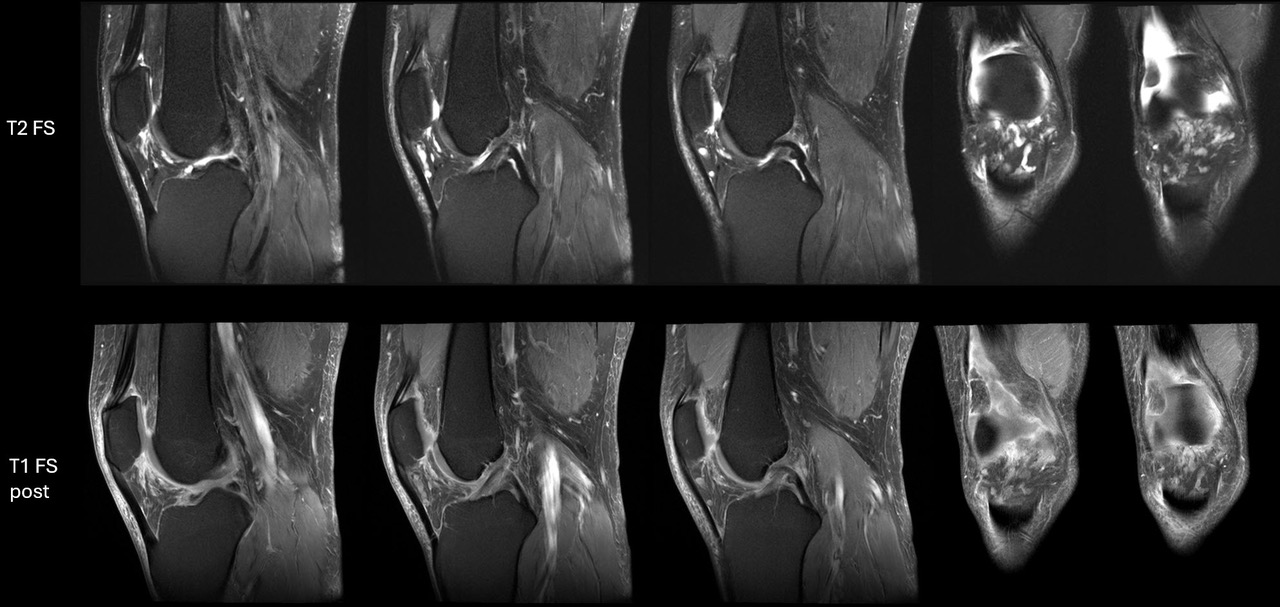
Here is a companion case from San Diego. 50-year-old man.with tubular masses in both Hoffa’s fat pads. They weren’t present on bilateral knee MRI exams from 10 years prior, but since then he has had 11 high molecular weight HA injections – all bilateral, done without image-guidance. We brought him back for post-contrast imaging and the lesions showed slow, gradual enhancement. His right knee images are attached, and like your case, the findings were essentially identical on the other side.
I think our cases fall in the spectrum of chronic granulomatous foreign body reactions, which was nicely summarized in a recent case report in Skeletal Radiology (https://doi.org/10.1007/s00256-024-04824-y). Reactive vascular channels have been seen in these lesions (https://doi.org/10.2106/jbjs.d.02436), and these may be so prominent that they can mimic a low flow vascular malformation (https://doi.org/10.1016/j.radcr.2023.10.007).
History is key as a true vascular malformation looks identical (as reported here: https://doi.org/10.1016/s0968-0160(03)00097-8).
My opinions are subject to change depending on what pathology shows (if we ever get it). 😂
Thanks,
Eric
On Aug 2, 2025, at 11:49, Phillip Tirman MD <ptirmanmd> wrote:
55 y/oF with history of Bilateral Primary osteoarthritis. She had radiographs that were negative for arthrosis or phleboliths. I was writing this up for OCAD and thought I needed to consider differentials so I went in search.
These initially looked to me like Hoffa’s fat pad venous malformations (used to be called synovial hemangiomas).
Very interesting that they are bilateral and essentially identical. Couldn’t find any inherited syndromes with this feature. I have never seen this before but know full well that my personal observations have nothing to do with the actual incidence of disease, a fact I learned in residency oh so long ago. I dictated as probably vascular.
As I was writing this post to ask opinions (which I would still like to hear), I scoured through all of her paperwork and interestingly the patient has received Bilateral Orthovisc injections. I thought since these are symmetrical bilaterally as well as weird, is it possible that they are the result of the injections? In order to not look any more ignorant since I didn’t know where these are usually injected into the knee, I asked AI: Where in the knee is orthovisc typically injected? A Sports Medicine clinic’s website has the injection image here in this post as the webpage header!
I think I received my answer. I will now amend my reports.
<Syn Hemang L1.jpg>
<Syn Hemang L2.jpg>
<Syn Hemang R1.jpg>
<Syn Hemang R2.jpg>
<Image 8-2-25 at 11.32.jpg>
